If God Knows the Future, Is Free Will an Illusion?
Free will and Fate: How Does God See the Future If We Have Choice?
Disclaimer: I’m not a theologian — these are just my personal thoughts on the topic.
Note: I’m a Russian-Orthodox Christian, so this is based on our world view.
The question that bothers everyone
If God already knows which path I’ll choose — is my will truly free?
This is where most people get stuck, and honestly, it’s a fair thing to struggle with. But I think the confusion comes from mixing up two very different things: foreknowledge and predestination.
Foreknowledge means God simply knows what will happen. Predestination means God causes everything to happen — like a puppet master pulling strings. These are not the same thing. Not even close.
God sees the whole tree and knows which path you will walk — but His knowledge doesn’t push you down that path. You still walk it freely.
How does it work?
Free will doesn’t mean our decisions are random or unpredictable. It means we face infinitely many possibilities at every moment. Each choice we make opens up new branches — and those branches depend on our environment, other people’s free will, and countless interactions.
Think of your life as a tree: at every decision point, new branches appear. When you add other people, circumstances, and interactions, it becomes a complex graph — everything interconnected.
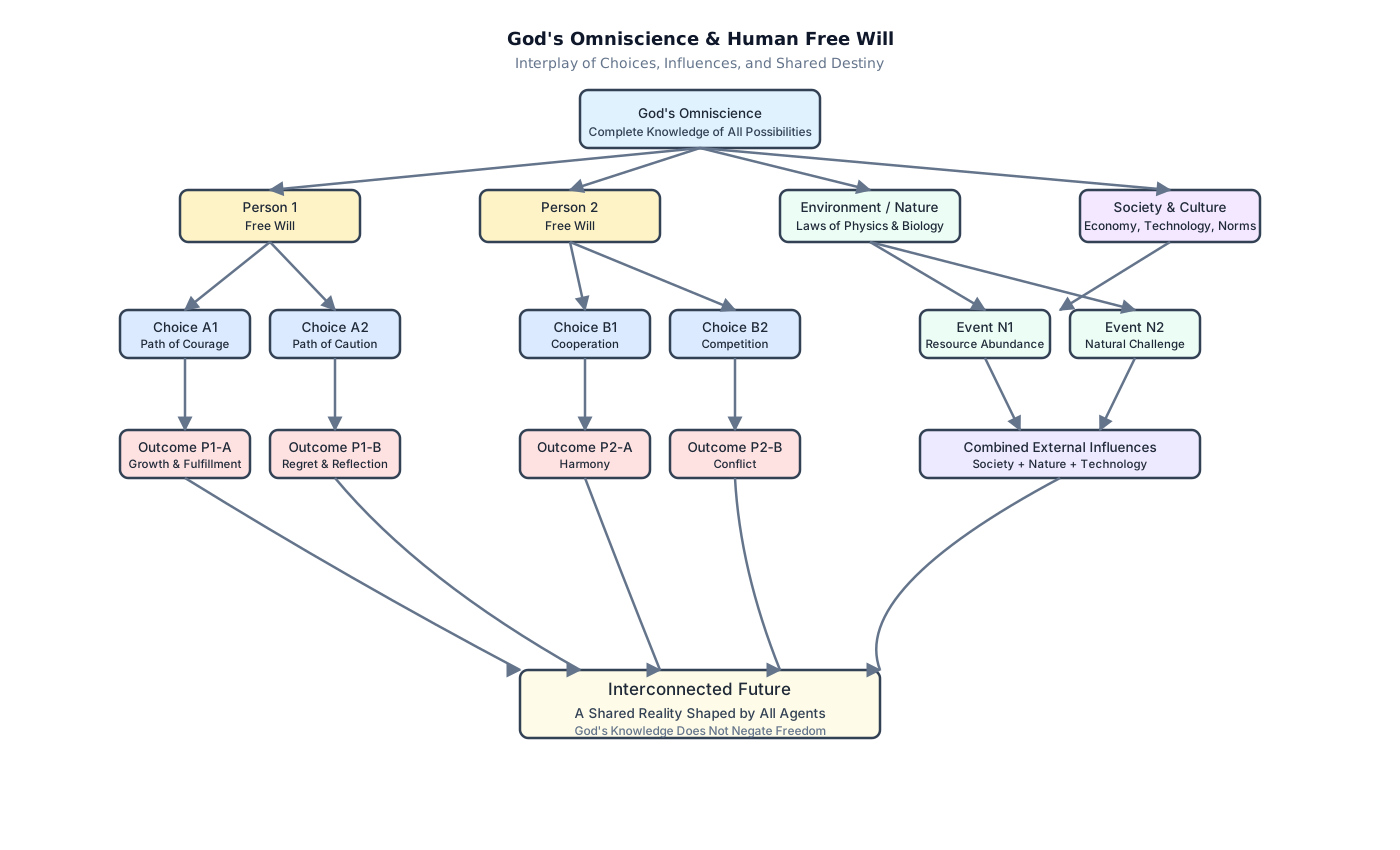
God, being outside of time and all-powerful, sees the entire picture. Not just one future — every possible future, while also knowing which path we will ultimately take.
God doesn’t “look ahead” — He sees it all at once
Since God exists outside of time and space, He doesn’t peer into the future the way we’d imagine if time-travel were possible. The entire timeline is now to Him.
His knowledge of your choice is more like seeing you make it — not predicting it from the past.
(Proverbs 16:9 captures this well: “The heart of man plans his way, but the Lord establishes his steps.”)
But doesn’t knowing the outcome mean it was never really my choice?
Here’s the part I find most beautiful.
Think of a parent who knows their child will choose chocolate ice cream over vanilla. Not because they forced it — but because they know their child. They love them deeply, they’ve watched them, they understand them. That knowledge doesn’t take away the child’s freedom to reach for the chocolate. It just means the parent knows them well enough to see it coming.
Now imagine that kind of knowledge, but infinite.
Divine foreknowledge is not divine force. If God can perfectly predict your choice, it doesn’t mean you aren’t free — it means He loves and knows you so completely that your freely made choice is already clear to Him. His knowledge is observational, not manipulative.
The fact that God knows us that deeply isn’t something that should feel threatening. It should feel like being known.
Conclusion
Free will and God’s sovereignty are not enemies. They work together in a way our finite minds can’t fully map out — but the heart of it isn’t a cold logical paradox. It’s a relationship. Our choices are real and meaningful, and God holds all of it — not because He controls us, but because He knows us.